Romania is undergoing an unprecedented energy transformation. Over the past five years, installed solar and wind energy capacity has grown exponentially, surpassing 7 GW nationally. This rapid growth, while necessary to achieve the decarbonization targets set under the European Green Deal, puts enormous pressure on the power grid. Intermittent production — the sun does not shine at night, and the wind does not blow constantly — creates major imbalances between supply and demand, threatening the stability of the entire national energy system.
The solution to this challenge goes by an increasingly familiar name: BESS — Battery Energy Storage Systems. Lithium-ion battery energy storage systems have the ability to absorb surplus energy during periods of high production and inject it back into the grid precisely during peak consumption. This balancing mechanism is not just an option — it is an absolute necessity for an energy system where the share of renewable sources exceeds 30% of the energy mix. Without storage, we risk the paradoxical situation of having green energy that we cannot use.
The European Union recognizes this urgency. Through the EUR 150 million funding scheme dedicated to energy storage in Romania, the European Commission is facilitating massive investments in BESS infrastructure. This funding, combined with balancing market mechanisms — FCR (Frequency Containment Reserve), aFRR (automatic Frequency Restoration Reserve) and mFRR (manual Frequency Restoration Reserve) services — creates a viable economic framework for storage project developers. Revenue from these services can ensure a return on investment within 5-8 years, an attractive timeframe for investors.
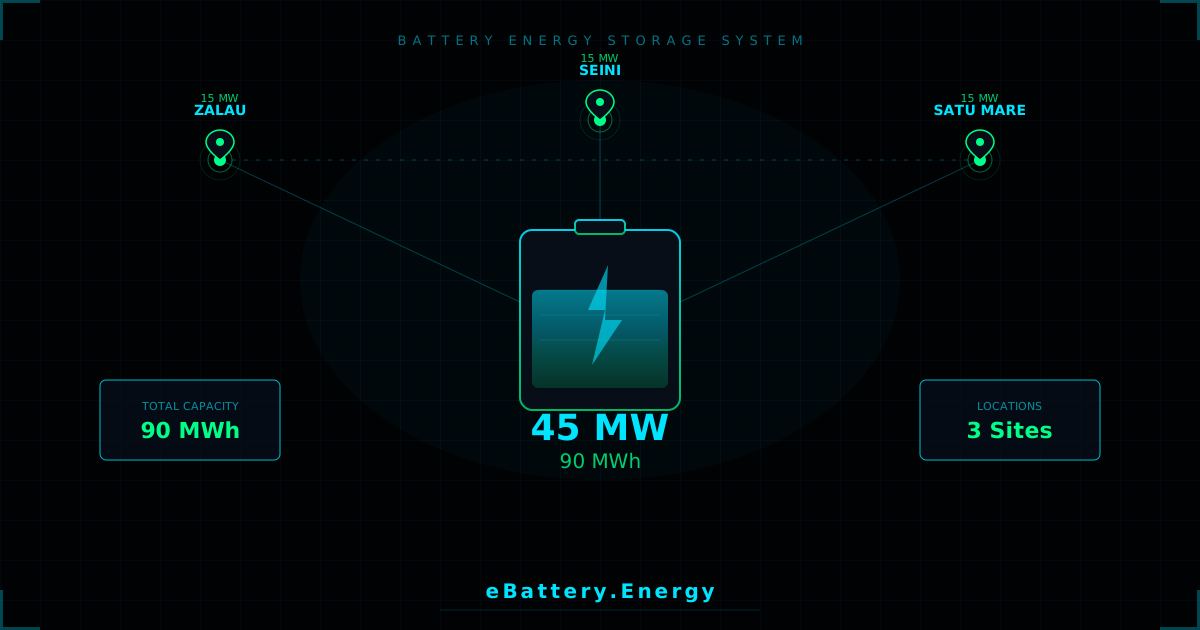
At eBattery.Energy, we have developed a portfolio of 45 MW / 90 MWh strategically distributed across northwest Romania. The locations in Zalau, Seini and Satu Mare were deliberately chosen — each is in proximity to a Transelectrica substation, enabling direct connection to the high-voltage grid and efficient participation in the balancing market. This strategic positioning reduces transmission losses and maximizes the value of every MWh stored.
Romania stands at an energy crossroads. Countries investing now in storage — Germany, the United Kingdom, Italy — will dominate the European energy market over the next decade. By developing BESS capacity, Romania is not only securing its power grid but also positioning itself as a relevant player in the European balancing services market. This is an opportunity we cannot afford to miss, and 2026 is the year these projects move from the planning phase to execution.