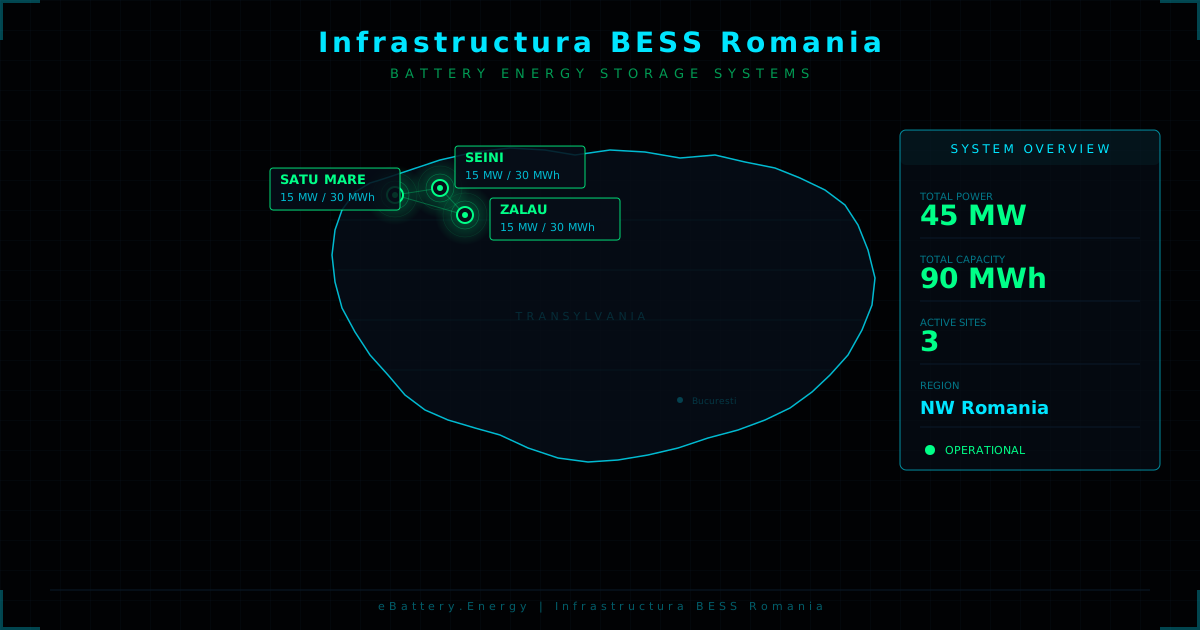
Northwest Romania is becoming a strategic hub for electricity storage. Three locations — Zalau (Salaj County), Seini (Maramures County) and Satu Mare — have been selected for the development of lithium-ion battery storage parks with an individual capacity of 15 MW / 30 MWh each. The choice of these sites is not accidental: each is located in the immediate vicinity of a Transelectrica transformer substation, enabling direct connection to the 110 kV high-voltage grid and efficient participation in the system services market.
Strategic positioning near Transelectrica infrastructure offers major competitive advantages. Connection costs are significantly reduced compared to isolated locations, and the battery response time — under 200 milliseconds — enables the provision of all types of balancing services required by the system operator. FCR (Frequency Containment Reserve) services require a response within 30 seconds, aFRR (automatic Frequency Restoration Reserve) within 5 minutes, and mFRR (manual Frequency Restoration Reserve) within 15 minutes. Lithium-ion batteries excel at all these services, being the only technology capable of simultaneously delivering both speed and flexibility.
The Energybat Capital project in Seini deserves special attention. With a capacity of 10 MW / 20 MWh and latest-generation Huawei modules, this project represents one of the most advanced BESS installations in Romania. The Huawei Smart String ESS modules use LFP (lithium iron phosphate) cells, a chemistry that offers over 6,000 charge-discharge cycles, a lifespan exceeding 15 years and a superior safety profile compared to traditional NMC cells. The estimated investment ranges between 3 and 8 million euros, and revenue from balancing services ensures a return on investment in approximately 6 years.
The northwest region presents a unique energy context. The combination of growing wind energy capacity in the Salaj-Maramures area and a grid infrastructure that requires modernization creates an acute need for local storage solutions. Batteries not only stabilize grid frequency but can also act as energy "buffers" during periods of transmission line congestion. This "decongestion" function is becoming increasingly valuable as more wind and solar parks come online in the region.
The total portfolio of 45 MW / 90 MWh developed through eBattery.Energy positions northwest Romania as one of the most important energy storage zones in the country. According to press reports, including in Transilvania Business and Dincolo de Sport, these projects attract attention not only for the scale of the investment but also for the innovative business model that combines storage with intelligent energy market trading. The year 2026 marks the transition from planning to execution, and the results will be visible in the stability of the power grid across the entire region.